Radon when buying or selling a home in Arvada
Testing during the inspection period, what a high number means for the deal, and getting a system in before closing.
What it usually costs
- Radon test during inspection: roughly $150 to $300, often added on by the home inspector
- A typical mitigation system at $1,000 to $2,500 is a common negotiation item: a seller credit, a price reduction, or a system installed before closing
Ranges are rough Denver-metro figures gathered from public cost guides and are only a starting point. Your contractor's written quote is the number that counts.
For buyers
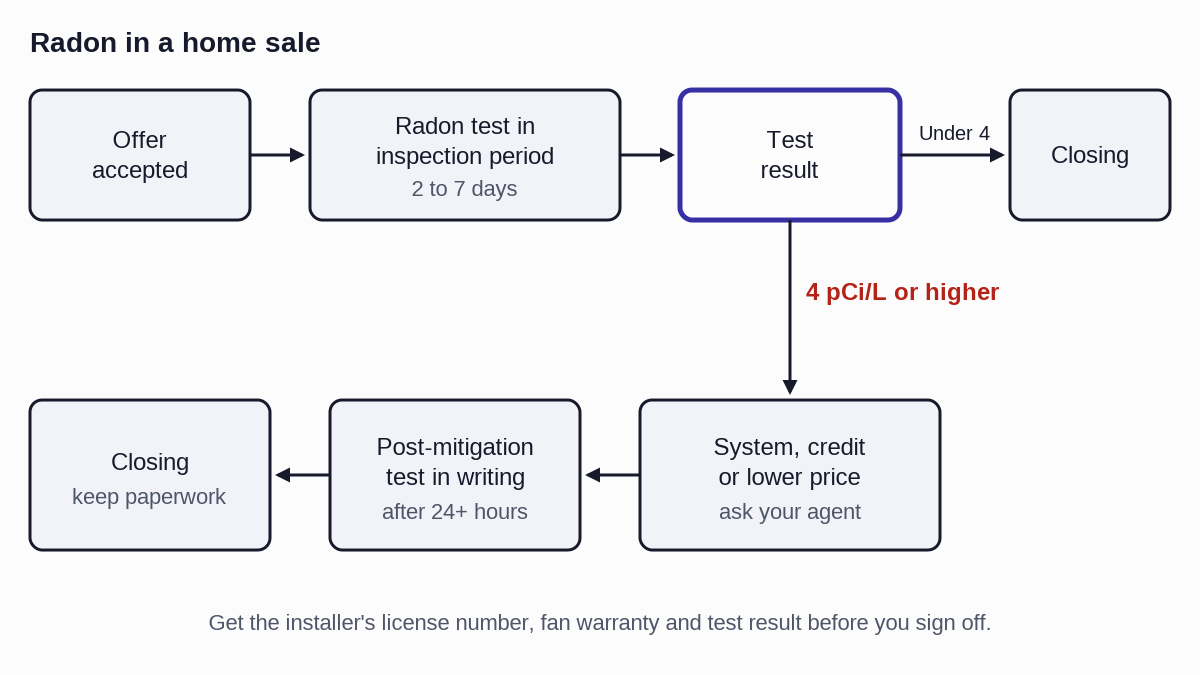
Order a radon test inside your inspection period, alongside the general inspection. If it comes back at or above 4 pCi/L, you can ask the seller to install a system, give a credit, or lower the price. Ask your agent how the contract deadlines apply.
For sellers
Colorado sellers are generally expected to disclose known radon test results and give buyers the state's radon information. Rules and forms change, so confirm the current requirements with your agent. If you already have a system, have the paperwork and a recent post-mitigation test ready.
If a system goes in before closing
- Get the installer's license number and a written description of the work
- Make sure a post-mitigation test is done, and get the result in writing
- Ask about the fan warranty and whether it transfers to the buyer
- Buyers: look at where the pipe runs before signing off, since it is hard to move later
What to ask
- Can you test and report within my inspection deadline?
- Will the test use a continuous monitor with tamper detection?
- Can you install before closing, and how soon can the follow-up test run?
Where this service is available
Arvada, Olde Town and central Arvada, Northwest Arvada and Candelas, Westminster, Wheat Ridge, Broomfield, Golden, Lakewood.
Get a free quote
Takes about a minute. Questions? Email [email protected].
Related services
Radon testing
Find out your actual number before anyone sells you a system. DIY kits work; a licensed test helps when a sale or a dispute is involved.
Sub-slab radon system install
The standard fix for basements and slab floors: a pipe under the slab, a fan, and a vent above the roof.
Crawl space radon mitigation
For tri-levels and homes with dirt or gravel crawl spaces: a sealed plastic membrane over the ground with a fan pulling from underneath.
System check and fan replacement
For homes that already have a system: a dead fan, a flat gauge, a noisy motor, or a retest that came back high.
New construction and passive systems
Many newer homes have a passive radon pipe built in. If the test is still high, adding a fan is often the simplest fix.