Radon in Olde Town and central Arvada homes
The oldest housing in the city, plus postwar ranches nearby. Older basements, additions and sump pits all shape the fix.
Older houses, more ways in
Around Olde Town and the blocks of central Arvada, many homes date from the early 1900s through the postwar ranch boom. Older basements tend to have more ways for soil gas to get in: block or stone walls, cracked floors, dirt sections under stairs, and floor drains.
Common situations here
- Additions on a separate slab. A ranch with a basement plus a later family room on its own slab may need a suction point under each.
- Partial basements. Some older homes have a basement under one part of the house and a crawl space or dirt area under another.
- Sump pits and floor drains. An open sump is a direct path for soil gas. It needs a sealed, removable lid.
- Block walls. Hollow block foundations can carry soil gas up inside the walls and sometimes need extra sealing.
If you are buying here
Older homes change hands often around Olde Town. Test during your inspection period, and ask how the pipe would route if a system is needed: the answer depends a lot on the layout and finishes.
What to ask
- Will one suction point cover the whole house, or do the addition and basement need separate points?
- How will you seal the sump and floor drains?
- Can the pipe route through a closet or garage instead of the front of the house?
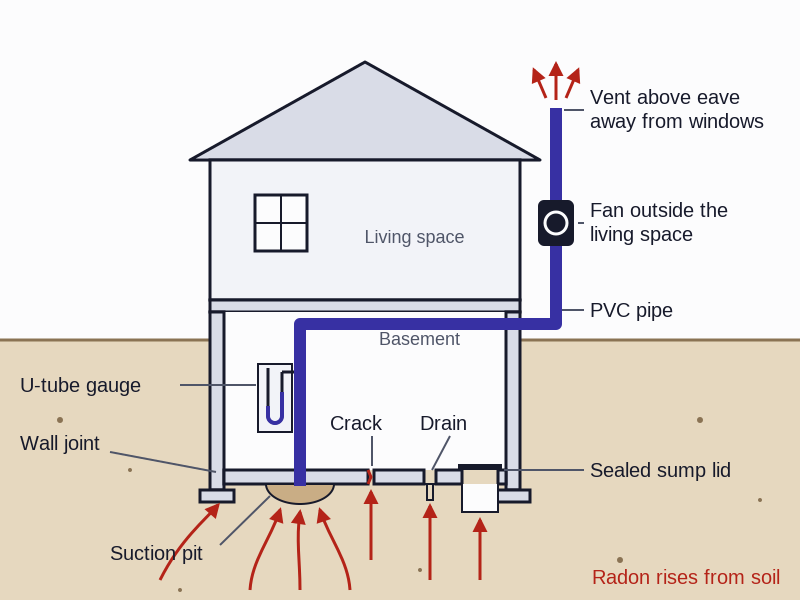
Services in Olde Town and central Arvada
Radon testing
Find out your actual number before anyone sells you a system. DIY kits work; a licensed test helps when a sale or a dispute is involved.
Sub-slab radon system install
The standard fix for basements and slab floors: a pipe under the slab, a fan, and a vent above the roof.
Crawl space radon mitigation
For tri-levels and homes with dirt or gravel crawl spaces: a sealed plastic membrane over the ground with a fan pulling from underneath.
Radon for home buyers and sellers
Testing during the inspection period, what a high number means for the deal, and getting a system in before closing.
System check and fan replacement
For homes that already have a system: a dead fan, a flat gauge, a noisy motor, or a retest that came back high.
New construction and passive systems
Many newer homes have a passive radon pipe built in. If the test is still high, adding a fan is often the simplest fix.
Nearby: Arvada, Northwest Arvada and Candelas, Westminster, Wheat Ridge, Broomfield, Golden, Lakewood.
Get a free quote in Olde Town and central Arvada
Takes about a minute. Questions? Email [email protected].