Radon mitigation in Wheat Ridge
Postwar ranches on large lots, many with basements and later additions. Sealing and suction point placement matter here.
Postwar ranches on big lots
Much of Wheat Ridge's housing went up in the 1950s and 1960s: brick ranches, often with basements, many with additions and finished lower levels added over the decades.
Common issues
- Older basement floors with cracks, floor drains and gaps at the walls
- Additions on a separate slab that the original system does not reach
- Finished basements where the pipe has to go through a closet or up the outside
- Older sump pits with no lid or a loose one
A good system here
Expect a diagnostic step before the quote: the contractor drills a small test hole and checks how well suction travels under the slab. That decides how many suction points the house needs.
What to ask
- Did you check whether the addition sits on its own slab?
- How will you seal the sump and floor drains?
- Can the pipe run through the garage instead of the side of the house?
Services in Wheat Ridge
Radon testing
Find out your actual number before anyone sells you a system. DIY kits work; a licensed test helps when a sale or a dispute is involved.
Sub-slab radon system install
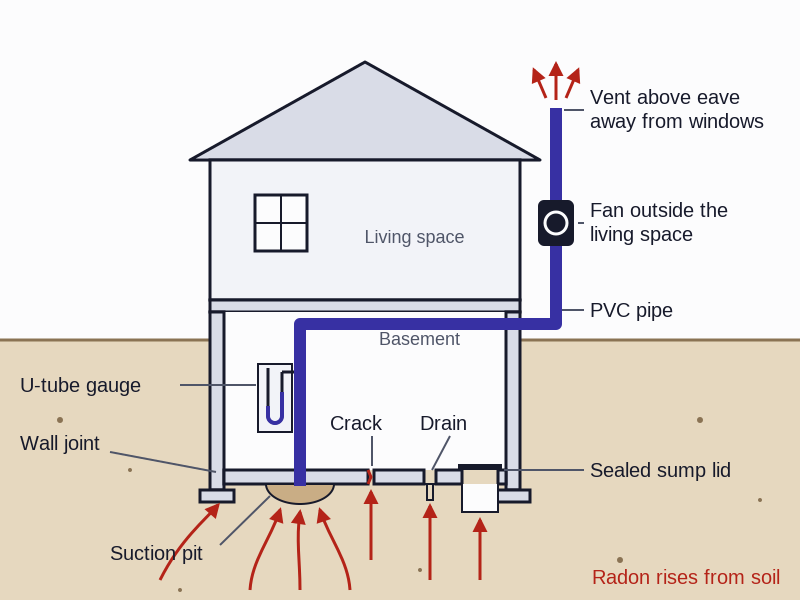
The standard fix for basements and slab floors: a pipe under the slab, a fan, and a vent above the roof.
Crawl space radon mitigation
For tri-levels and homes with dirt or gravel crawl spaces: a sealed plastic membrane over the ground with a fan pulling from underneath.
Radon for home buyers and sellers
Testing during the inspection period, what a high number means for the deal, and getting a system in before closing.
System check and fan replacement
For homes that already have a system: a dead fan, a flat gauge, a noisy motor, or a retest that came back high.
New construction and passive systems
Many newer homes have a passive radon pipe built in. If the test is still high, adding a fan is often the simplest fix.
Nearby: Arvada, Olde Town and central Arvada, Northwest Arvada and Candelas, Westminster, Broomfield, Golden, Lakewood.
Get a free quote in Wheat Ridge
Takes about a minute. Questions? Email [email protected].