Radon system check and fan replacement in Arvada
For homes that already have a system: a dead fan, a flat gauge, a noisy motor, or a retest that came back high.
What it usually costs
- Fan replacement with a common inline radon fan: roughly $300 to $700 installed
- Service call to diagnose a system: often $100 to $250
- Adding a suction point or resealing a sump lid when a system underperforms: priced by the job
Ranges are rough Denver-metro figures gathered from public cost guides and are only a starting point. Your contractor's written quote is the number that counts.
Signs the system needs attention
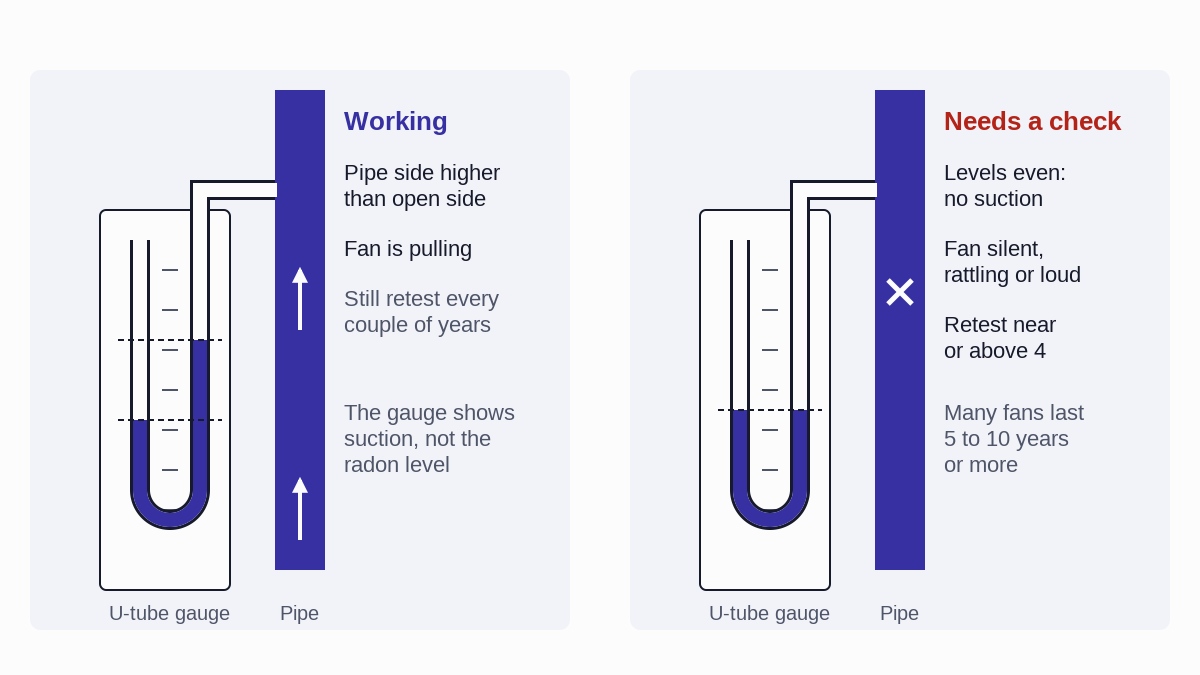
- The liquid in the U-tube gauge is level on both sides, which usually means no suction
- The fan is silent, rattling or much louder than it used to be
- A retest comes back near or above 4 pCi/L
- You finished the basement or added on, and nobody looked at the system
How long fans last
Radon fans run around the clock, and many last somewhere around 5 to 10 years or more. Fans in hot attics or on exterior walls in cold weather can wear differently. The EPA suggests retesting every couple of years even with a working system, and after any big change to the house.
Winter notes
Exterior fans and pipes can collect condensation that freezes in hard cold. A contractor can check the pipe slope and drainage so water runs back down instead of icing up the fan.
What to ask
- Is this the right fan size for my system, or was the original undersized?
- Can you check the sump lid, floor drains and cracks while you are here?
- Will you retest after replacing the fan?
Where this service is available
Arvada, Olde Town and central Arvada, Northwest Arvada and Candelas, Westminster, Wheat Ridge, Broomfield, Golden, Lakewood.
Get a free quote
Takes about a minute. Questions? Email [email protected].
Related services
Radon testing
Find out your actual number before anyone sells you a system. DIY kits work; a licensed test helps when a sale or a dispute is involved.
Sub-slab radon system install
The standard fix for basements and slab floors: a pipe under the slab, a fan, and a vent above the roof.
Crawl space radon mitigation
For tri-levels and homes with dirt or gravel crawl spaces: a sealed plastic membrane over the ground with a fan pulling from underneath.
Radon for home buyers and sellers
Testing during the inspection period, what a high number means for the deal, and getting a system in before closing.
New construction and passive systems
Many newer homes have a passive radon pipe built in. If the test is still high, adding a fan is often the simplest fix.