Best Time to Test for Radon in Colorado: Why Winter Works
Winter is the easiest time to get a reliable radon test in Colorado. Here is why, how to set up a test properly, and what to do with your result.
Published November 25, 2026 · Arvada Radon Help
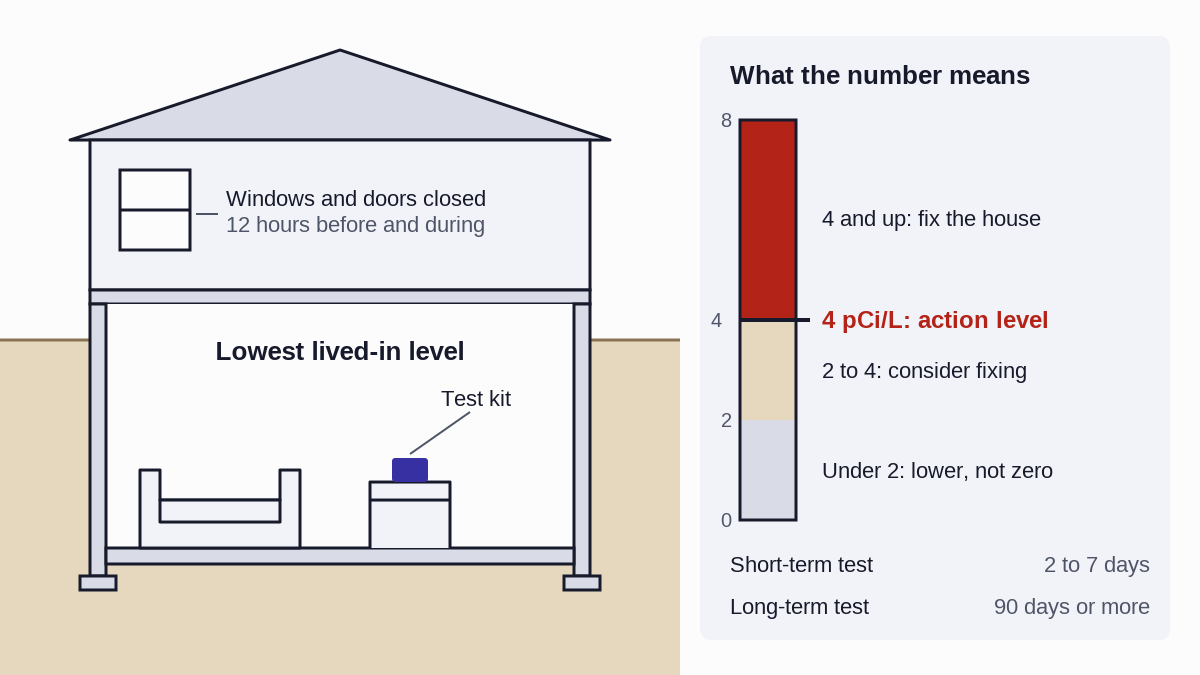
The best time to test for radon in Colorado is the heating season, roughly late fall through early spring, when windows and doors stay shut and radon tends to build up indoors. You can test any time of year as long as the house is closed up, but winter makes that easy, and it shows the home close to its worst case.
If you want help setting up a test or making sense of a result, the radon testing page explains how this referral service connects you with an independent local contractor. The rest of this guide covers why winter matters, how to run a test that holds up, and what to do next.
Why radon runs higher in winter
Radon is a gas that comes from uranium in rock and soil. Colorado has a lot of it. CU Anschutz points to the state's uranium-bearing granite as one reason Colorado levels are higher than in many other states, and puts the average Colorado home at 6.4 pCi/L. The EPA action level is 4.0 pCi/L.
Three things push indoor radon up in cold months:
- The house is sealed. Jefferson County Public Health notes radon is highest in winter and lower in summer, when windows and doors are often open. Less fresh air means radon has nowhere to go.
- Warm air rises and pulls soil gas in. Larimer County and CSU Extension describe this as the stack effect: warm indoor air moves up and out, and the house draws replacement air from below, including through the foundation.
- Frozen ground can act like a lid. The same Larimer County release notes frozen soil can block radon from escaping outdoors, which leaves more of it to find its way into a basement.
Jefferson County also points out that exhaust fans and heating systems that create negative pressure inside the home can increase radon entry. Furnaces, bath fans and dryers all run more in winter.
What this means for your test result
CSU Extension notes that readings averaged over a whole year are usually lower than a basement reading taken in winter. That is useful to know in two ways.
First, a winter test is a conservative check. If a basement tests low in January with the house closed up, that is reassuring. Second, a high winter number is still a real signal, but it is one snapshot. Short tests capture a few days. Long tests average out the seasonal swings and give a better picture of what you breathe year round.
Short-term or long-term test
There are two main types, and both have a place:
- Short-term tests run from about two days up to 90 days, depending on the device. Jefferson County's kit is a short-term test meant to sit out about four days. They are quick and cheap, which makes them a good first screen.
- Long-term tests run 90 days or more. CU Anschutz and the Wisconsin health department both describe these as the better estimate of a home's annual average. Wisconsin recommends that a long-term test span both heating and non-heating seasons.
A common approach is to start with a short-term test in winter. If it comes back at 4 pCi/L or higher, Wisconsin's guidance is to run a second test to confirm. For results above 8 pCi/L, it suggests making that second test a short-term one so you get an answer sooner.
How to set up a test that counts
A test is only as good as the conditions around it. Based on Jefferson County and Wisconsin guidance:
- Close the house first. Keep exterior doors and windows closed for at least 12 hours before a short-term test starts, and through the whole test. Normal coming and going is fine.
- Pick the lowest lived-in level. For most Arvada-area homes with basements, that is the basement. Put the kit 2 to 6 feet off the floor.
- Keep it away from drafts. Jefferson County says at least 3 feet from windows, doors, vents or other airflow.
- Leave it alone for the full time. Note the start and end dates and times on the form.
- Mail it promptly. Jefferson County notes kits not analyzed within 11 days of opening cannot be read, so send it to the lab right away.
Winter helps with step one. Nobody is opening windows in a cold snap, so closed-house conditions happen almost on their own.
Getting a test kit
Per Jefferson County Public Health, Colorado residents can get a free kit through the Colorado Department of Public Health and Environment, limited to one per household. The county health department has also sold kits for $10, and hardware and home stores carry them. CSU Extension puts store kits at roughly $10 to $50. Free kit supplies are limited and programs change from year to year, so check with the state or county before counting on one.
January is National Radon Action Month, and Colorado counties often push free kits then, which lines up with the best testing window.
Does this apply in Arvada and the northwest metro?
Yes. CSU Extension notes that every county in Colorado is in EPA Zone 1, the highest radon potential designation. Jefferson County reports that about half of homes in the county test above the EPA action level. In its own 2025 kit program, a little over half of returned tests from county residents came in over 4 pCi/L.
That lines up with what you see across Arvada and neighboring cities: newer homes, older homes, slab or basement, the only way to know is to test. Radon varies house to house, even on the same street.
If your result is high
A confirmed result at or above 4 pCi/L is the point where mitigation is recommended. Most systems in Colorado use a fan and pipe to pull soil gas from under the foundation and vent it outside. Costs vary a lot with the house. Jefferson County lists a range of about $1,250 to $1,500, while CU Anschutz gives $1,000 to $3,000 and CSU Extension cites $800 to $2,500. A written quote for your specific home is what counts.
CDPHE also runs a low-income radon mitigation assistance program for qualifying Colorado homeowners. It is worth checking before you get quotes if cost is a concern.
If you already have a system, winter is a good time to check it too. CSU Extension notes EPA recommends retesting a mitigated home every two years. If the fan is quiet, the gauge looks off or a new test reads high, see system check and fan replacement.
Buying or selling in winter? Real estate tests are usually short-term and on a deadline. The home buyers and sellers page covers how that usually works.
What to ask a contractor
Whether you want a professional test or a mitigation quote, a few questions help sort things out:
- Are you on the CDPHE list of certified radon professionals? CSU Extension notes the state publishes a list of certified mitigation contractors.
- What kind of test do you use, and how long will it run? Ask whether it is a continuous monitor or a lab-analyzed kit, and how they make sure closed-house conditions hold.
- Where will you place it, and why there? It should be the lowest lived-in level, away from drafts.
- If mitigation is needed, what will the system look like? Ask where the pipe and fan will go and how it will look from outside.
- Will you retest after the install? A post-mitigation test is how you know the system works.
- Is the quote in writing, with what is included? Get any warranty terms on the fan and the radon reduction in writing too.
When you are ready, the quote form passes your request to an independent local contractor. Any testing, pricing and work is between you and that contractor.
Need help with this?
Find out your actual number before anyone sells you a system. DIY kits work; a licensed test helps when a sale or a dispute is involved. More about radon testing.
Sources
Ranges are rough Denver-metro figures gathered from public cost guides and are only a starting point. Your contractor's written quote is the number that counts. General information only, not an inspection or a quote for your home.
Get a free quote
Takes about a minute. Questions? Email [email protected].